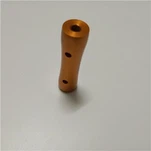
Shaft parts are one of the more common types of machine parts. Typically, shaft parts are constructed as a rotating body, generally longer than the diameter, and are used in a wide variety of machinery and equipment to support transmission parts, transmit torque and carry loads.
Most of the machinery and equipment will have transmission parts, and the transmission parts are mainly composed of gears and shaft parts. Shaft components are rotating cylindrical parts whose length is greater than their diameter, usually consisting of the outer cylindrical surface, conical surface, inner bore and threads of a concentric shaft, and the corresponding end surfaces.
Shaft parts are designed into various structural shapes depending on the workplace. Therefore, shaft parts can be divided into transmission shafts, stepped shafts, hollow shafts, and crankshafts according to their structural forms.

Commonly used equipment for shaft parts processing
Shaft parts are used in various mechanical equipment to transmit torque and bear load, so they have high requirements for size and accuracy. Usually, shaft parts go through a variety of processes from blank to finished product, and a variety of machining equipment is used.
There are many types of equipment used to machine shaft parts, including CNC lathes, machining centers, cylindrical grinders, and centerless grinders. When choosing the right machining equipment for shaft parts, it is necessary to consider the design drawings of the shaft parts and the finished parts to be qualified.
It is necessary to take into account not only the preparation of the CNC program of the machine but also the arrangement of the machining process of the shaft part, the machining machine, the machining tool, the positioning of the part in the machining clamping, and other factors. In addition, the operator must carry out a detailed CNC machining process analysis of the part design drawings and processing technology requirements, to determine its key technology, and processing difficulties, to select the appropriate model.
Shaft parts machining process
The main machined surfaces of shaft parts are external surfaces and commonly shaped surfaces. Therefore, the most suitable processing method should be selected according to various accuracy levels and surface roughness requirements. The basic machining processes can be summarized into four types. The first is the machining process from rough turning to semi-finishing turning and then to finish turning. This type of machining process is very suitable for the stepped shaft and hollow shafts, etc. The most important process for the selection of outer circle machining of shaft parts.
The second processing route is rough turning to semi-finishing turning, then to rough grinding, and finally using the finishing grinding process. For ferrous materials, high precision requirements, small surface roughness requirements, and shaft parts requiring quenching, this machining route is the best choice because finish grinding is the ideal subsequent machining process for shaft parts.
The third machining process for shaft parts is from rough turning to semi-finishing turning, and then to the finish turning process and diamond turning process. This process is specifically used for machining non-ferrous materials because non-ferrous metals have low hardness and tend to agglomerate. The gaps between the grains are usually not easy to obtain the required surface roughness by grinding, and the finishing turning and diamond turning process is required.
The final machining process is to complete the rough turning to the semi-finishing turning process for shaft parts, then to rough grinding then to finishing grinding, and finally to the finish grinding process. This machining process is a frequent process for shaft parts that have been hardened with ferrous materials and requires high machining accuracy and low surface roughness values.