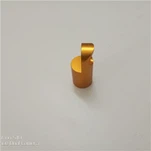
CNC machining encompasses a wide range of machining applications. Because of its programmability, a CNC machine can perform a wide range of functions with minimal human intervention. A CNC machine is used to make a component. This term refers to subtractive manufacturing processes that involve removing material from a workpiece or bar to create a finished component. Five different CNC machines perform five different types of common CNC machining.
1. CNC Milling machine
CNC milling machines are distinguished by their ability to rotate cutting tools while remaining stationary with the material workpiece/block. They can make a variety of shapes, such as face-milled features (shallow, flat surfaces and cavities in the workpiece) and peripheral milled features (deep cavities such as slots and threads). CNC milling machine components are typically square or rectangular in shape and have a variety of features.
2. CNC Lathes and Turning Machines
CNC lathes and turning machines rotate (turn) materials during machining. Cutting tools are fed in a linear motion along the rotating bar stock, removing material around the circumference until the desired diameter is reached.
CNC Swiss lathes are used by Pioneer Service (a subset of CNC lathes). CNC Swiss lathes rotate the material and slide it axially through a guide bushing (a holding mechanism). The part features will be better supported (resulting in better/tighter tolerances) when the tooling supports them.
Internal and external features on the component, such as holes, bores, broaches, reamed holes, slots, tapping, tapers, and threads, can be created using a CNC lathe or turning machine. Screws, bolts, shafts, and poppets are examples of CNC lathe and turning center components.
3. CNC Laser Cutting Machines
CNC laser machines use a pointed router with a highly focused laser beam to cut, slice, or engrave materials precisely. The laser heats the material, causing it to melt or vaporize and leaving a cut in it. The material is typically in sheet form, and the laser beam moves back and forth across the material to create a precise cut.
This process can generate a broader range of designs than traditional cutting machines (lathes, turning centers, mills), and it frequently generates cuts and/or edges that do not require additional finishing processes.
CNC laser engravers are frequently used to mark (and decorate) machined components. It can be difficult, for example, to machine a logo and company name into a CNC turned or CNC milled component. However, even after the machining operations are completed, laser engraving can be used to add this to the component.

4. The CNC plasma cutting machine
Materials are also cut using CNC plasma-cutting machines. A computer-controlled plasma torch (electronically-ionized gas) is used to perform this procedure. A plasma torch functions similarly to a handheld, gas-powered welding torch (up to 10,000 degrees Fahrenheit). Using a plasma torch, a cut in the material is created by melting through the workpiece.
The material being cut must be electrically conductive whenever CNC plasma cutting is employed. Typical materials include steel, stainless steel, aluminum, brass, and copper.
The precision CNC machining process provides a wide range of production capabilities for components and finishes in the manufacturing environment. It depends on the environment of use, the materials required, the lead time, the volume, the budget, and the features required to deliver the desired outcome.
5. Electrical Discharge Machines, CNC (EDM)
CNC electric discharge machines (EDMs) manipulate materials using highly controlled electrical sparks. It is also known as spark eroding, die sinking, spark machining, or wire burning.
The electrode wire is placed under a component, and the machine is programmed to emit an electrical discharge that produces intense heat (up to 21,000 degrees Fahrenheit). In order to create the desired shape or feature, the material is melted or flushed away with liquid.
In a component or workpiece, EDM is most commonly used to create precise micro holes, slots, tapered or angled features, and other more complex features. It is typically used for very difficult metals that are difficult to machine to the desired shape or feature. The typical gear is a good example of this.