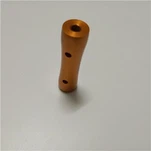
According to the classification of metallographic organization, stainless Steel Turned Part is divided into ferritic stainless steel, martensitic stainless steel, austenitic stainless steel, and duplex (in the austenitic matrix with ferrite) stainless steel:
(1) Ferritic stainless steel
Cr content is typically between 13% and 30% when chromium is the predominant alloying element. At high temperatures, it has good resistance to oxidizing media corrosion and air oxidation resistance, and it can also be utilized as heat-resistant steel. This steel has poor welding ability. Containing more than 16% chromium, the cast state organization is coarse, and there will be a "475 °C" brittle phase and phase so that the steel becomes brittle at 400-525 °C and 550-700 °C between long-term insulation. Brittle at 475 °C and Cr ferritic orderly phenomena are connected. 475 °C brittle phase and phase brittle can be improved by heating to 475 °C °C higher and then rapidly cooling. Room temperature brittleness and post-weld heat-affected zone brittleness are also fundamental issues with ferritic stainless steel, which can be addressed through vacuum refining, the addition of trace elements (such as boron, rare earth, and calcium, for example), or austenite-producing elements (such as Ni, Mu, N, Cu, etc.). To improve the mechanical qualities of the weld zone and heat-affected zone, a small amount of Ti and Nb are frequently added to avoid grain growth in the heat-affected zone. Ferritic steels ZGCr17 and ZGCr28 are commonly utilized. This type of steel has a low impact toughness and is frequently replaced with austenitic stainless steel with high nickel content. Ferritic steel with more than 2% Ni and more than 0.15% N offers good impact characteristics.
(2) Martensitic stainless steel
Martensitic stainless steel including martensitic stainless steel and precipitation-hardening stainless steel. In engineering applications, the main purpose of the mechanical properties. Although these steels have good corrosion resistance in atmospheric corrosion and more moderate corrosive media (such as water and certain organic media), their corrosion performance is often not a test item. The range of its chemical composition is Cr13%-17%, Ni2%-6%, and C≤0.06%. The metallographic organization is mainly low-carbon slate-like martensite, therefore, has excellent mechanical properties, a strength index more than two times that of austenitic stainless steel, and at the same time has good process performance, especially welding performance. Therefore, it occupies an extremely important position in important engineering applications and is an important branch in the field of foundry stainless steel.

(3) Austenitic stainless steel
Austenitic stainless steel is classified into four types: Cr-Ni, Cr-Ni-Mo, Cr-Ni-Cu, and Cr-Ni-Mo. The famous "18-8" represents the -Cr-Ni system to the famous Cr-Ni system. The Mo-Cu system adds 2%-3% molybdenum and copper (or both) to the Cr-Ni system to improve sulfuric acid corrosion resistance; however, molybdenum is a ferrite-forming element, thus the Ni concentration should be increased after molybdenum addition to assuring austenitization. The -N system is a nickel-saving alloy. When the Cr content exceeds 15%, adding mang alone does not result in the optimal austenite organization; instead, 0.2%-0.3% nitrogen is required, and more than 0.35% nitrogen is required to obtain single austenite. As the amount of N content is too high often makes castings produce pores, loosening, and other defects, and with the addition of a moderate amount of N and a small amount of Ni, you can get single austenite, which appears as Cr-Ni-Mn-N system. Of course, to get austenite, ferrite complex phase organization, it is not necessary to add more N and Ni.
(4) Austenitic-ferritic complex-phase stainless steel
Complex-phase steel metallographic organization usually contains 5%-40% ferrite to improve the weldability of the alloy, increase strength and improve stress corrosion resistance. For example, Cr28%-Ni10%-C0.30% high-carbon, high-chromium alloy steel, with good resistance to sulfuric acid corrosion, can be manufactured for use in castings. On the basis of this development can be controlled ferrite type steel, there is a high strength, and the sulfate has good resistance to stress corrosion, commonly used in the oil industry devices.