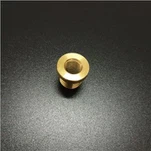
In our country, precision machining has high precision and high machining cost. It is mainly used in civil and military fields, such as national defense, medical equipment, aerospace, and electronic products. With the continuous development of China's industrial structure optimization and upgrading, the demand for mechanical parts machining is also increasing, therefore, it is highly valued.
And precision machining is not all materials can be, some materials are too hard, and more than the hardness of the machined parts, it is possible to crumble the machine parts. So these materials are not suitable for precision machining unless it is a special material made of machine parts or laser cutting.
The materials for precision machining can be divided into two kinds: metal materials and non-metal materials. For metal materials, the hardness is greater for stainless steel. The next is cast iron, followed by copper, and finally aluminum, while the processing of ceramics, plastics, etc. is the processing of non-metallic materials.

In the requirement of material hardness, for some occasions, the higher the hardness of the material, the better. Only limited to the hardness requirements of the processing machine parts, the processing material can not be too hard, if harder then the machine parts can not be processed. In addition, the material is moderately soft and hard, at least one grade lower than the hardness of the machine parts. Also depends on the role of the processed device to do what with the machine parts reasonable selection of materials. In short, precision machining requirements of the material or some of the material is not what material is suitable for processing. For example, too soft or too hard material, the former is not necessary to process, and the latter is not processed.
When processing precision parts it should follow what aspects of the requirements?
The first is the dimensional requirements, which must strictly follow the drawing of the shape tolerance requirements for processing. Although the enterprise processing production parts in practice and the size of the drawings will not be the same, the actual size in the tolerance range of theoretical dimensions, are qualified products and can use the parts.
Second, the equipment requirements, rough and finish machining should be used for different performance equipment, due to the roughing process is to cut most of the parts of the gross bad. The workpiece in the case of large feed, cutting depth will produce a large number of internal stress, then can no longer finish machining. The workpiece in a certain period after the finishing process should be in a higher precision machine tool work so that the workpiece can reach a high degree of accuracy.
Again, the processing of precision parts often has surface treatment and heat treatment processes, surface treatment should be placed after precision machining. And in the process of precision machining, should be considered to leave a thin layer of thickness after surface treatment, heat treatment is to improve the cutting properties of the metal, so it needs to be placed before machining.